
Choctaw County Genealogy Lookup
Choctaw County genealogy records are kept at the courthouse in Hugo, the county seat. Marriage records, divorce filings, probate files, and court documents all start in 1907 when Oklahoma became a state. The county was carved from Choctaw Nation lands, so tribal records play a big role in family research here. The Choctaw County Genealogical Society is active and can help you navigate local collections. You can search court case records online for free through the state system, or contact the clerk by phone or mail to request copies of older documents. The county also has probate records on microfilm at FamilySearch going back to 1853.
Choctaw County Overview
Choctaw County Court and Clerk Offices
The Choctaw County Court Clerk holds marriage records, divorce filings, probate documents, and court records from 1907 to the present. For marriage record requests, call (580) 326-7554. The general number is (580) 326-3778. The court clerk address is Choctaw County Courthouse, 3300 E. Jefferson St., Hugo, OK 74743.
The county clerk handles land records from 1907 forward and is located at 300 E Duke, Hugo, OK 74743. The fax number is (580) 326-6787. Office hours are Monday through Friday, 8:00 AM to 4:00 PM. Note that this office closes at 4:00, which is a half hour earlier than most Oklahoma county offices.
| Court Clerk | 3300 E. Jefferson St., Hugo, OK 74743 |
|---|---|
| Marriage Records | (580) 326-7554 |
| County Clerk | 300 E Duke, Hugo, OK 74743 |
| General Phone | (580) 326-3778 |
| Hours | Monday through Friday, 8:00 AM to 4:00 PM |
Birth and death certificates are available through the Health Department for $15.00 each. These are state records, not county records. The county clerk can point you to the right office if you need vital certificates.
Choctaw County Marriage and Vital Records
Marriage records at the court clerk start in 1907. Each file shows the names of the parties, their ages, residences, date of the ceremony, and the name of the officiant. These records are open to the public under the Oklahoma Open Records Act, Title 51 Section 24A.5. Anyone can request copies. The fee is no more than $0.25 per page for standard copies or $1.00 per page for certified copies.
Divorce records also start in 1907. The court clerk keeps the full case files. You can search Choctaw County court records online through the Oklahoma State Courts Network. Select "Choctaw" from the county dropdown. The system is free and covers cases from the mid-1990s to the present.
Choctaw County Genealogy Resources
The Choctaw County OKGenWeb page is a strong free resource for researchers. It has maps, marriage record indexes, name indexes, and county history compiled by volunteers. If you are just starting your search, this site gives you a good overview of what records exist and where to find them.
Here is the Choctaw County OKGenWeb portal with links to free genealogy data and historical records for this area.
Volunteers add new transcriptions regularly as they work through old records from the courthouse and private collections.
The Choctaw County Linkpendium page pulls together genealogy links from across the web. It covers census data, church records, cemetery listings, and more.
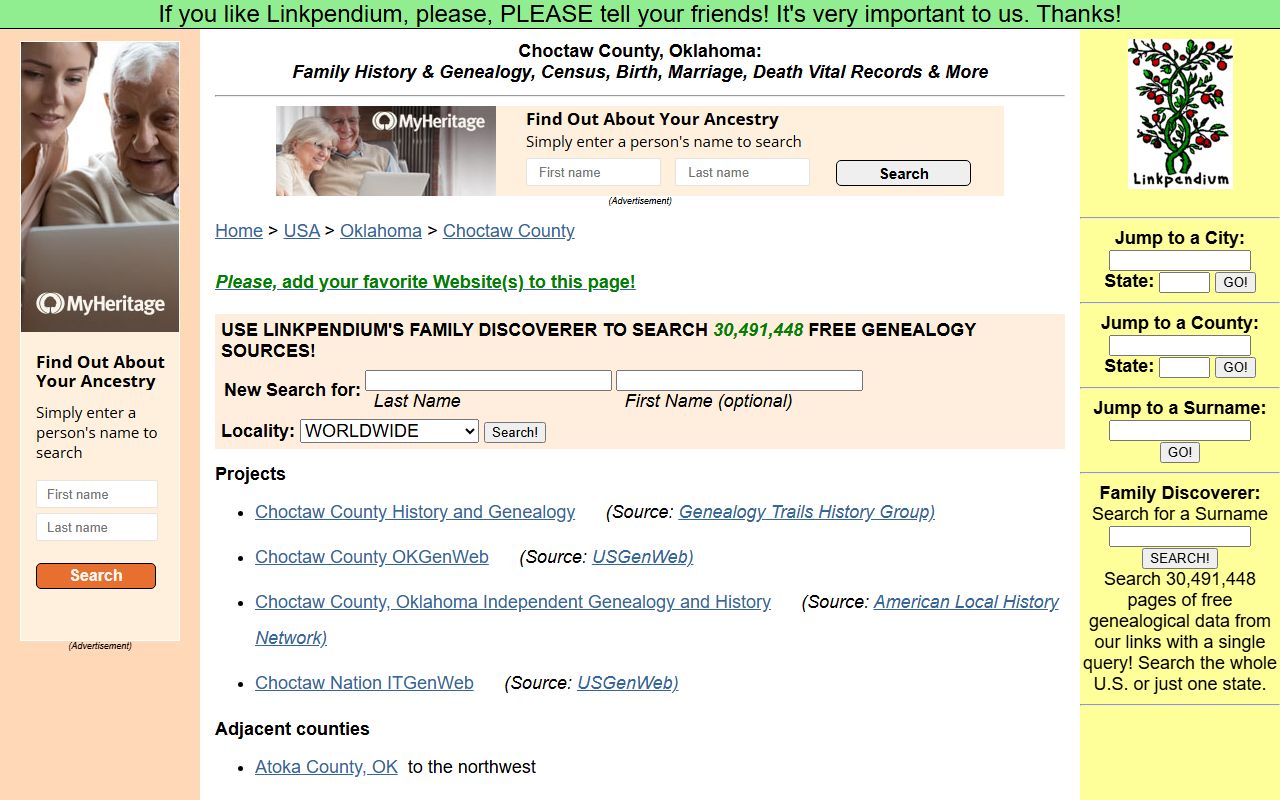
Use this directory to find niche databases and small archive projects you might not discover on your own.
Choctaw County Genealogical Society
The Choctaw County Genealogical Society is one of the more active local groups in southeast Oklahoma. You can write to them at P.O. Box 2, Hugo, OK 74743 or call (580) 969-9863. Their email is choctawcountyokgensoc@live.com. Members can help with research questions and may have access to records and family files that are not available online or at the courthouse.
The society works with local libraries, churches, and families to gather and preserve genealogy records. They hold meetings where members share findings and discuss research methods. If you are stuck on a Choctaw County family line, this group is worth reaching out to. Local knowledge can open doors that online databases cannot.
Tribal Records and Choctaw County History
Choctaw County was part of the Choctaw Nation before Oklahoma statehood. The Dawes Commission records at the Oklahoma Historical Society cover Choctaw tribal enrollment from 1898 to 1906. These rolls contain names, ages, blood quantum, and census card numbers. The enrollment packets include family testimony and other genealogy details.
Probate records at the court clerk go back to 1907, but FamilySearch has microfilmed probate records for Choctaw County from 1853 to 1952. That takes you back to well before statehood. These microfilm reels cover wills, estate settlements, and guardianship documents from the Choctaw Nation period. Check the FamilySearch catalog for film numbers and viewing locations.
Funeral homes in Hugo include Miller And Miller Funeral Home, Mt. Olive Funeral Home, and Prater-Lampton-Mills and Coffey Funeral Home. Their records can list birthplaces, parents' names, and surviving family members. The Oklahoma Historical Society Research Center provides free access to Ancestry Library Edition and old newspapers through the Gateway to Oklahoma History. The National Archives at Fort Worth has Bureau of Indian Affairs records that cover Choctaw County families.
Under Oklahoma Statutes Title 63 Section 1-323, birth records are restricted for 125 years and death records for 50 years. Marriage, probate, and land records are open to anyone. The BLM General Land Office Records has federal land patents for this county.
Cities in Choctaw County
Hugo is the county seat and the place to go for all genealogy records. Other communities include Boswell, Fort Towson, Soper, and Sawyer. All records are filed through the courthouse in Hugo.
Nearby Counties
Choctaw County is in the far southeast corner of Oklahoma. These neighboring counties may have records for family members who lived in this part of the state.