
Access Osage County Genealogy
Osage County genealogy records are held at the courthouse in Pawhuska, the county seat. This is the largest county in Oklahoma by land area and carries a unique history tied to the Osage Nation. Records at the courthouse date back to 1907 when Oklahoma became a state. You can search court cases online through the Oklahoma State Courts Network for free, or visit the courthouse to access older files. The court clerk keeps marriage licenses, probate records, divorce documents, and court cases. Land records are at the county clerk's office. For researchers with Osage ancestry, tribal records and federal archives add layers of genealogy data not found at the county level alone.
Osage County Overview
Osage County Court Clerk
The Osage County Court Clerk manages marriage records, divorce files, probate documents, and court cases from 1907 forward. Wills, estate files, guardianship papers, and civil case records are all on file. These are the backbone of genealogy research in Osage County. The court clerk can search by name or case number and produce copies of documents you need.
The courthouse is at 600 Grandview Avenue in Pawhuska. You can reach the court clerk at (918) 287-4104. Office hours are Monday through Friday, 8:00 AM to 4:30 PM. Walk-in visitors should bring a photo ID and as much identifying information as possible. A full name, birth date, or approximate year of the event will help staff pull the right files quickly. Written mail requests are also accepted.
| Office | Osage County Court Clerk |
|---|---|
| Address |
Osage County Courthouse 600 Grandview Avenue Pawhuska, OK 74056 |
| Phone | (918) 287-4104 |
| Hours | Monday through Friday, 8:00 AM to 4:30 PM |
Osage County shares Judicial District 10 with Pawnee County. If you have ancestors who moved between the two, records might be in either courthouse.
How to Search Osage County Genealogy Records
Start with the Oklahoma State Courts Network. It is free and covers Osage County. Select "Osage" from the county dropdown, then search by name or case number. The system shows divorce filings, probate cases, civil suits, and criminal records. Online records go back to the mid-1990s for most case types.
Older records require a trip to the courthouse in Pawhuska or a written request by mail. The county clerk handles land records, deeds, and mortgages from 1907 forward. Copy fees follow state law. Under the Oklahoma Open Records Act, Title 51 Sections 24A.1 through 24A.33, standard copies cost $0.25 per page and certified copies cost $1.00 per page plus a certification fee.
The OK2Explore database from the Oklahoma State Department of Health provides free searches of birth and death records. Birth records become open after 125 years and death records after 50 years under Title 63 Section 1-323 of the Oklahoma Statutes. Marriage and divorce records are public with no waiting period.
Osage County Genealogy Online Resources
The Oklahoma Historical Society maintains extensive records related to Osage County. The OHS Research Center in Oklahoma City holds territorial records, Indian census rolls, and manuscript collections. Below is a view of the Oklahoma Historical Society research portal, which provides access to multiple genealogy databases.
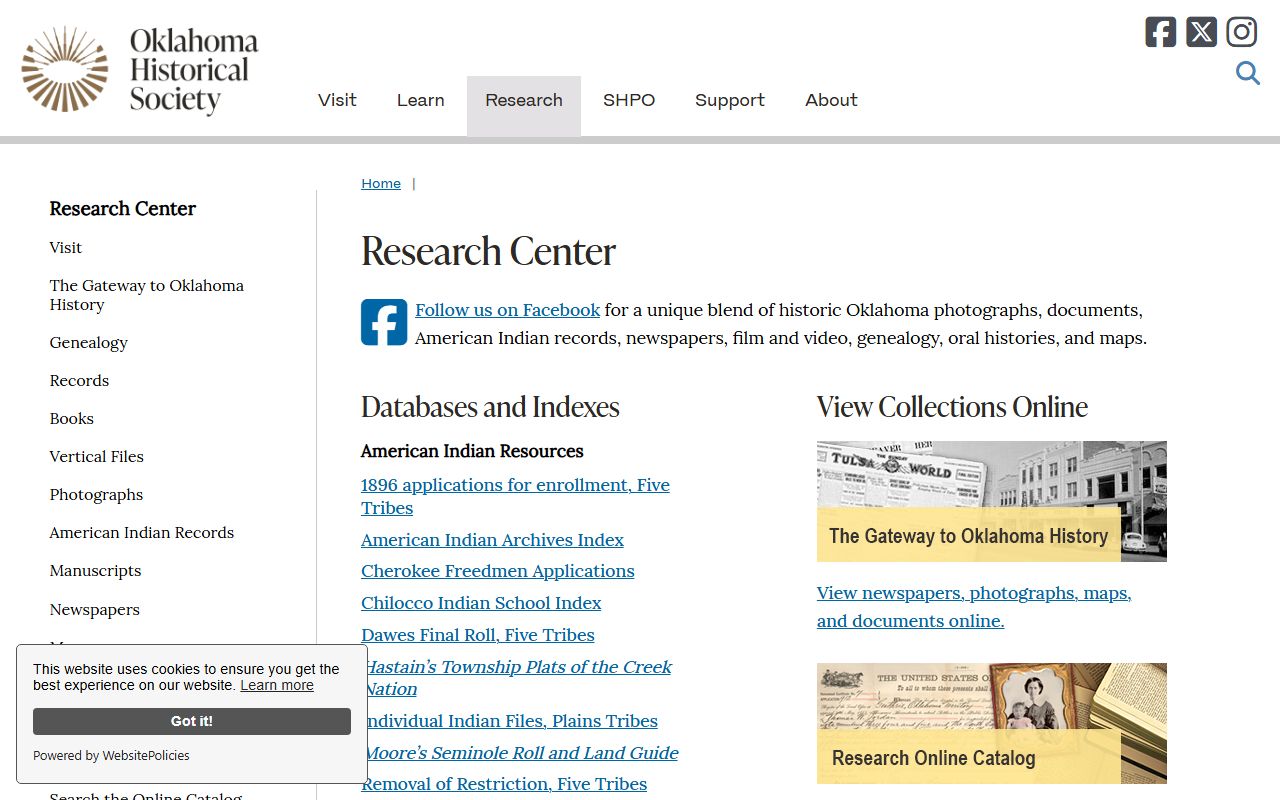
The research center offers free in-person access to Ancestry Library Edition, Fold3, HeritageQuest, and Newspapers.com. Their reading room at 800 Nazih Zuhdi Drive is open to the public.
The Gateway to Oklahoma History has digitized newspapers from the Pawhuska area and other Osage County towns. You can search obituaries, marriage announcements, and community news at no cost. Old issues of the Pawhuska Journal-Capital and other local papers are in the collection. The Oklahoma Genealogical Society also has links to county-specific resources and research guides on their website.
Osage Nation Records and Genealogy
Osage County has a one-of-a-kind history. The Osage Nation purchased this land from the Cherokee in 1872, and the entire county sits within the Osage reservation. Unlike other Oklahoma counties that were carved from Indian Territory during allotment, the Osage maintained mineral rights beneath their land. This distinction created a unique set of records tied to oil, gas, and headright payments that can be valuable for genealogy research.
The Dawes Commission records cover the Five Civilized Tribes but not the Osage directly. However, the Osage Allotment Act of 1906 created its own set of enrollment and allotment records. These are held at the National Archives at Fort Worth along with Bureau of Indian Affairs records for Oklahoma. The Fort Worth facility has Osage agency files, school records, and annuity payment rolls. Contact them at (817) 551-2051.
The Osage Nation Museum in Pawhuska also holds historical records and photographs. For ancestors who were Osage citizens, combining tribal records with county courthouse files gives the most complete picture of family ties and property ownership.
Note: Osage headright and mineral estate records may require specific authorization from the Osage Nation or the Bureau of Indian Affairs to access.
Land and Probate Records in Osage County
Land records at the county clerk's office start in 1907. Deeds, mortgages, and plat maps are on file. Because the entire county was Osage reservation land, early property records often connect to allotment rolls and trust land agreements. Federal land patents can be searched at the Bureau of Land Management GLO Records site for free, though Osage allotments followed a different process than typical homestead patents.
Probate records at the court clerk begin in 1907. These include wills, estate inventories, guardianship files, and heir determinations. Probate cases in Osage County sometimes involve headright distribution, which makes them unusually detailed compared to other counties. An estate file might list not just property and money, but also mineral rights shares and tribal enrollment details. The Oklahoma Genealogical Society can help point you to the right resources for working through complex Osage County probate matters.
Cities in Osage County
Pawhuska is the county seat. All genealogy record requests go through the courthouse there. Other communities in Osage County include Hominy, Fairfax, Barnsdall, Skiatook, Sand Springs (partly in Tulsa County), and Cleveland. None have their own records offices for genealogy purposes.
Nearby Counties
Osage County borders several counties in north and northeast Oklahoma. If your family lived near the county line, check these neighbors too.